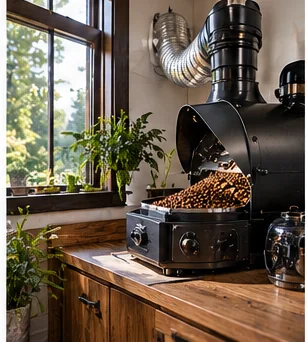
Products and configurations to compare
Window exhaust fan high airflow
Useful as secondary room ventilation.
Best when: manufacturer permits indoor roasting and room smoke is the problem
Watch for: does not capture smoke at source
Metal coffee roaster exhaust duct kit
Use heat-appropriate materials and manufacturer guidance.
Best when: roaster has a supported exhaust connection
Watch for: duct temperature/fire-clearance requirements matter
Activated carbon air purifier
Helpful for remaining odor, not primary smoke disposal.
Best when: residual room odor remains after proper exhaust
Watch for: not a substitute for venting significant roast smoke
Roast level changes smoke production
Darker development generally produces more visible smoke and odor.
Source capture beats room cleanup
Capturing exhaust near the roaster is more effective than filtering the entire kitchen afterward.
Chaff is combustible debris
Keep collectors and surrounding surfaces clean.
Window position and neighbors matter
Exhausting directly onto a patio or neighboring window can simply move the problem.
Test with a small batch
Validate airflow before committing to a large dark roast indoors.
Home roasting adds smoke, chaff and heat to the coffee hobby
The roaster is only one part of the setup. Cooling, ventilation, chaff collection, a scale, fire-safe placement and storage for green beans all affect whether home roasting is pleasant enough to continue. Darker roasts and larger batches generally create more smoke and stronger odor.
Ventilation equipment should move smoke outside safely without creating a fire or carbon-monoxide hazard from unrelated appliances. Do not improvise combustible ducting near hot exhaust or defeat roaster safety systems. Indoor roasting beyond what the manufacturer supports can require a proper hood or dedicated location.
Cooling is part of the roast profile
Beans continue changing while hot. A dedicated cooling tray or strong manufacturer-designed cooling cycle helps stop development predictably. The best cooling system is one that handles the full batch quickly without blowing chaff across the kitchen.
Before checkout
- Exact machine/grinder model and size standard are confirmed
- Product solves a specific workflow, taste or maintenance problem
- Water chemistry is measured before treatment is chosen
- Replacement parts match OEM dimensions/specifications
- Food-contact materials are appropriate
- Electrical/plumbing modifications are within your skill level
- Counter space and storage are measured
- Consumables remain easy to replace
- Cleaning requirements are realistic
- Return policy allows compatibility testing
The expensive mistake is solving the wrong problem
Coffee gear is unusually good at turning a small inconsistency into a shopping list. Before buying, write the complaint in one sentence: “my machine scales every three months,” “I cannot reproduce a declining-flow shot,” “my grinder retains 0.7g,” or “I need to preserve three coffees for two months.” If the product does not address that sentence directly, it is probably a distraction.
Compatibility is the second filter. Diameter labels such as 58mm, “E61,” or 64mm burrs can look standardized while hiding important dimensional differences. Verify model, revision and actual measurements before ordering aftermarket hardware.
First-week test
Keep the old workflow as a baseline. Measure or taste several repetitions before and after the change, alter one variable at a time, and use the return window if the gear adds friction without producing a clear benefit. For maintenance parts, check for leaks, unusual noise, heat, binding or calibration changes before returning the machine to unattended daily use.
Good coffee gear should disappear into the routine. If a tool requires five minutes of setup to save ten seconds of brewing time, it needs to deliver a flavor or maintenance benefit large enough to justify that trade.
Frequently asked questions
Can I roast coffee indoors?
Only within the roaster manufacturer's ventilation/safety guidance and with adequate exhaust for the smoke produced.
Will an air purifier remove roast smoke?
It can help with residual particles/odor but should not replace proper exhaust for significant smoke.
Can I use dryer duct?
Use materials and configurations appropriate to the roaster's exhaust temperature and manufacturer requirements.
Does light roast need ventilation?
Yes; even lighter roasting creates odor, chaff and some smoke.
Current sources
Affiliate disclosure: CoffeeGear.co may earn from qualifying purchases through Amazon Associates and eBay Partner Network at no extra cost to you. Amazon links use scouttheory-20; eBay links use campaign 5339137014.