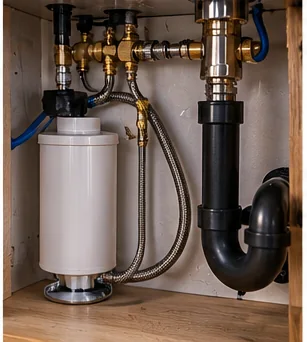
Products and configurations to compare
Inline coffee water filter system
Choose cartridge chemistry after testing water.
Best when: you have a rotary-pump/plumbable machine
Watch for: must be sized to source water and flow
Food-safe pressure regulator and gauge
A visible gauge simplifies setup and troubleshooting.
Best when: manufacturer specifies inlet range
Watch for: wrong fittings or pressure can cause leaks/performance issues
Smart water leak sensor with shutoff
A floor/cabinet sensor can catch a slow leak when nobody is in the kitchen.
Best when: machine is permanently connected to plumbing
Watch for: does not replace sound plumbing
Start with the machine manual
Connection size, maximum inlet pressure and drain requirements are model-specific.
Use a dedicated shutoff
The machine should be isolatable without turning off water to the whole kitchen.
Drain lines need continuous fall
A plumbed drip tray can become an odor/clog problem if the hose sags.
Avoid hidden push-fit jungles
Every fitting is a possible leak; simplify the path.
Document cartridge and hose dates
Future maintenance is easier when install history is known.
Water treatment is about chemistry and machine protection, not just taste
Espresso machines concentrate the consequences of bad water because they repeatedly heat the same mineral-bearing supply inside narrow passages, valves and boilers. Hardness, alkalinity, chloride and total dissolved solids each affect a different part of the problem. A filter that makes tap water taste cleaner may remove chlorine while doing almost nothing to reduce scale. A softener can reduce calcium scale while changing flavor. Reverse osmosis can remove most minerals but then needs controlled remineralization for both taste and machine compatibility.
The right starting point is therefore measurement. CoffeeGear already has a water-test guide for TDS, hardness and GH/KH. Use that data to choose treatment rather than buying the filter with the most stages.
Plumbed machines raise the stakes
A reservoir machine can be protected by manually mixing suitable water. A direct-plumb machine continuously consumes whatever enters the line, so filtration capacity, bypass setting, pressure regulation and cartridge replacement schedule become part of machine ownership. Install a shutoff valve where it is accessible, allow enough space to change cartridges and avoid hiding leak-prone fittings where a slow drip can damage cabinets unnoticed.
Before checkout
- Exact machine/grinder model and size standard are confirmed
- Product solves a specific workflow, taste or maintenance problem
- Water chemistry is measured before treatment is chosen
- Replacement parts match OEM dimensions/specifications
- Food-contact materials are appropriate
- Electrical/plumbing modifications are within your skill level
- Counter space and storage are measured
- Consumables remain easy to replace
- Cleaning requirements are realistic
- Return policy allows compatibility testing
The expensive mistake is solving the wrong problem
Coffee gear is unusually good at turning a small inconsistency into a shopping list. Before buying, write the complaint in one sentence: “my machine scales every three months,” “I cannot reproduce a declining-flow shot,” “my grinder retains 0.7g,” or “I need to preserve three coffees for two months.” If the product does not address that sentence directly, it is probably a distraction.
Compatibility is the second filter. Diameter labels such as 58mm, “E61,” or 64mm burrs can look standardized while hiding important dimensional differences. Verify model, revision and actual measurements before ordering aftermarket hardware.
First-week test
Keep the old workflow as a baseline. Measure or taste several repetitions before and after the change, alter one variable at a time, and use the return window if the gear adds friction without producing a clear benefit. For maintenance parts, check for leaks, unusual noise, heat, binding or calibration changes before returning the machine to unattended daily use.
Good coffee gear should disappear into the routine. If a tool requires five minutes of setup to save ten seconds of brewing time, it needs to deliver a flavor or maintenance benefit large enough to justify that trade.
Frequently asked questions
Can any espresso machine be direct-plumbed?
No. Use only manufacturer-supported or technically appropriate conversion paths.
Do I need a drain?
Some plumbed machines have drainable drip trays; others still require manual emptying.
Can I use refrigerator tubing?
Use tubing/fittings appropriate to food service, pressure and the machine's specifications.
Should a plumber install it?
If plumbing modifications exceed your skills, yes.
Current sources
- CoffeeGear — Best Descaling & Water-Softening Products
- CoffeeGear — Coffee Gear Maintenance Guide
- CoffeeGear — Best Water Test Kits & TDS Meters
Affiliate disclosure: CoffeeGear.co may earn from qualifying purchases through Amazon Associates and eBay Partner Network at no extra cost to you. Amazon links use scouttheory-20; eBay links use campaign 5339137014.