Does an Espresso Machine Fit Under Your Cabinets? Height Check
The spec-sheet height is only the start. Add room to lift a lid or slide out a tank, space for a portafilter handle and a steam wand, and a check on what your manual says about enclosed spaces.
Affiliate disclosure: CoffeeGear is reader-supported. When you buy through links on our site, we may earn a commission at no extra cost to you. We don't list prices because they change, so check the current listing and the seller's return window before you order.
Whether an espresso machine fits under your cabinets depends on more than its listed height. You need the machine's height with everything open, the clearance above it that the manual asks for, room to fill and empty the water tank, and space to move the portafilter and steam wand without hitting a wall or a shelf.
This guide gives you a measuring routine you can do in ten minutes with a tape measure and a cardboard box. It is written for kitchens where the counter, the cabinet and the outlet are all fixed, which is most of them.
Start with what the maker says
Manuals differ on this, so read yours before you measure. Two examples show the range.
- The Breville Barista Express Impress manual gives no clearance distances around or above the machine, and does not mention cabinets or shelves. It does say not to operate the appliance in an enclosed space or inside a cupboard, and to put it on a stable, heat- and water-resistant, level, dry surface.
- The Gaggia Anima manual says the machine shall not be placed in a cabinet when in use, and its figure shows a minimum of 15 cm of clearance on each side.
The Breville Barista Express, De'Longhi EC935X and Philips 3200 Series documents give no clearance distances either. If yours is silent, do not take that as permission: ask the maker how much space it wants above and around the machine. Steam and warm air rise, and the manuals above do not say what that does to a cabinet underside, so a tight gap deserves a question before you buy.
The measuring checklist
| Measure | How | Common trap |
|---|---|---|
| Cabinet height above the counter | Measure at the exact spot, from the counter to the lowest point of the cabinet, including any trim or light fitting | Measuring at the cabinet edge when a light bar or lip hangs lower |
| Machine height | Take it from the maker's spec page; note whether it includes feet, the lid and any raised parts | Spec heights that exclude a lid that opens upward |
| Depth | Measure from the wall or backsplash to the counter edge, including any overhang | A backsplash ledge or outlet cover that pushes the machine forward |
| Width | Add the machine's width to the clearance your manual asks for on each side | Forgetting the grinder, scale or cups that share the space |
| Cord and outlet | Check the outlet's position against the machine's cord | An outlet behind the machine that the cord cannot reach |
Keep the measurements in one place and compare them with the spec page, not with a picture. For help with outlets and cords, see our guide to machine power.
A tape measure or laser distance measure
A retractable tape works for most kitchens. A laser measure is handy for heights above a counter and for a second pair of hands that you do not have.
Water tanks and lids
This is where machines that fit on paper fail in practice. Water tanks come in several forms: a lid that lifts from the top, a tank you slide out from the front, side or back, and a tank you lift out upwards. A top-lift lid or tank needs space above the machine. A pull-out tank needs space in front or beside it.
- Find out how your machine's tank is accessed. Manuals and product pages describe it; for example, a Philips 3200 Series page lists front access, and a Breville manual describes a removable tank.
- If the tank lifts out upwards, measure the machine's height plus the height of the tank.
- If the tank slides out, check you can pull it out without moving the machine.
- If the machine is a bean-to-cup type, check where the hopper lid opens. Our super-automatic guide covers the brew unit and milk system that need access too.
If a machine has a removable tank that you must lift out through the top, you may find it easier to move the machine forward than to try to refill it in place. Plan for that when you choose the spot.
Steam wand and portafilter swing
The Breville manual says the steam wand must be positioned over the drip tray and away from people before the steam is turned on, and warns that pressurised steam can still be released after the machine has been switched off. So the wand has to move freely and point somewhere safe, and the space beside it matters.
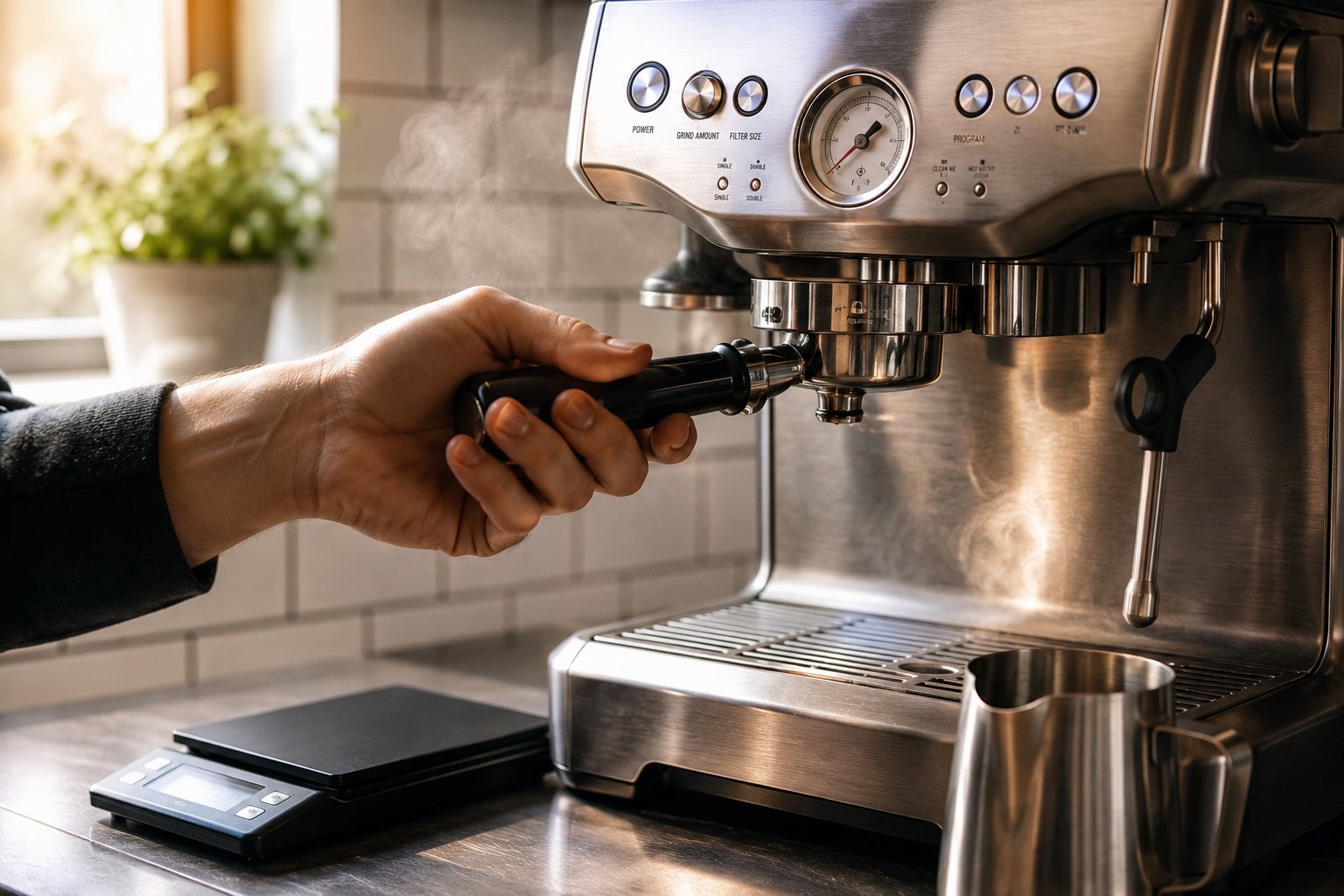
The portafilter handle also needs room. It sticks out to the front and swings when you lock it in, so measure the machine's depth with the handle on and the distance you need to turn it. A wall or cabinet that is close at the side can make that awkward.
The cardboard test
- Cut a cardboard box to the machine's width, depth and height from the spec page.
- Set it where the machine would sit and add a second piece of card for the portafilter handle.
- Open the cabinet door and check that nothing catches.
- Pretend to fill the tank and pull out the drip tray. If any step is awkward, the real thing will be too.
- Leave it for a day. If you keep moving it, the spot is wrong.
If it does not fit
- Do not run a machine inside a cabinet or cupboard. Two manuals above say so directly.
- Do not remove or raise a cabinet to fit a machine without a professional looking at it.
- Do not buy and hope. Check the return terms in case the machine does not fit.
Instead, move the machine to an open stretch of counter, use a different spot such as the end of a run, or choose a more compact model. Our small kitchen gear guide and this guide to coffee setups for tiny kitchens cover the options. If you are building a whole station, the home coffee bar guide shows how to lay it out, and our beginner machine guide lists models to compare once you know your measurements.
A compact espresso machine with a front-access tank
Search by size and tank access, then check the maker's spec page against your measurements before you buy.
A silicone mat or a small tray for the counter
Protects the counter and defines the footprint of the machine, which makes it easy to see how much space it takes.
Frequently asked questions
Can I use an espresso machine under a cabinet?
It depends on the maker. Some manuals say not to operate the machine in an enclosed space or cabinet, and many give no clearance figure. Check your manual and ask the maker if it is silent.
How much space should be above an espresso machine?
Your manual or the maker will say. Some manuals give no figure above the machine, so ask the maker rather than guessing.
Does the machine height on the spec sheet include the lid?
Not always. Check whether the figure is for the closed machine, and add the room needed to lift a lid or lift out a tank.
How do I check the steam wand clearance?
Check that the wand can swing to a position over the drip tray, away from people, and that nothing at the side or above blocks it.
What if I cannot find the dimensions?
Contact the maker or the seller, or check the manual. Do not buy until you can compare the real dimensions with your measurements.
- Breville Barista Express Impress instruction booklet: no clearance distances or cabinet guidance; do not operate in an enclosed space or inside a cupboard; steam wand positioned over the drip tray; steam can still be released after switching off; removable water tank.
- Gaggia Anima (120V) user manual: not to be placed in a cabinet when in use; figure showing 15 cm of clearance on each side.
- Philips 3200 Series (EP3241/74) product sheet: front-access water tank; no clearance distances given.
- Breville Barista Express (BES870XL) instruction booklet and De'Longhi EC935X manual: neither gives a clearance distance.
- No machine heights, depths or clearances are quoted beyond the Gaggia 15 cm figure. Get dimensions from the maker's spec page for your model, and ask the maker how much space it wants above and around the machine.