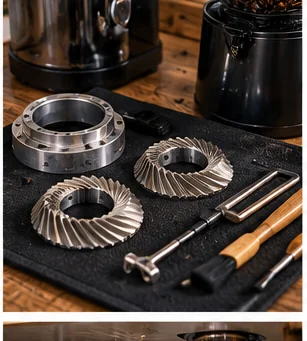
Products and configurations to compare
64mm aftermarket burr set SSP style
Popular route for DF64-class and other compatible flat-burr grinders.
Best when: your 64mm grinder is explicitly compatible and you want a defined flavor shift
Watch for: alignment and zero point must be checked after install
OEM replacement burr set
Safest maintenance choice.
Best when: old burrs are worn and you like current flavor
Watch for: does not create a new flavor profile
Burr alignment tools/shims
Use a repeatable method and stop when performance is good.
Best when: flat-burr carrier needs alignment verification
Watch for: DIY alignment can become obsessive without measurable problem
Burr geometry changes particle distribution
That changes how easily a coffee extracts and the balance of clarity/body.
Alignment matters more after an expensive upgrade
A premium burr mounted poorly can underperform stock.
Motor and chamber clearances still matter
Same nominal diameter does not guarantee compatibility.
Seasoning is not magic but burrs change with initial use
Expect grind settings and behavior to settle after early coffee.
Upgrade only after you understand the stock grinder
Otherwise you lose a useful baseline.
Grinder upgrades work only when they solve a named problem
Bellows, burrs, anti-popcorn inserts, declumpers and alignment shims can all change workflow or particle distribution, but upgrading everything at once makes it impossible to know which change helped. Start with the complaint: retention, static, grind-speed inconsistency, burr rub, insufficient espresso adjustment or a flavor preference for more clarity versus more body.
CoffeeGear already covers when burrs genuinely need replacement. An aftermarket burr should therefore be treated as a flavor/workflow modification, not routine maintenance. OEM burrs restore factory performance; specialty burr geometries can move the grinder away from its original balance.
Single dosing is a system
A bellows can push retained grounds out of a chamber, but it cannot turn every hopper grinder into a genuinely zero-retention design. Chute geometry, declumper, burr chamber volume and static still matter. Weigh input and output over several doses before deciding whether the retrofit solved the problem.
Before checkout
- Exact machine/grinder model and size standard are confirmed
- Product solves a specific workflow, taste or maintenance problem
- Water chemistry is measured before treatment is chosen
- Replacement parts match OEM dimensions/specifications
- Food-contact materials are appropriate
- Electrical/plumbing modifications are within your skill level
- Counter space and storage are measured
- Consumables remain easy to replace
- Cleaning requirements are realistic
- Return policy allows compatibility testing
The expensive mistake is solving the wrong problem
Coffee gear is unusually good at turning a small inconsistency into a shopping list. Before buying, write the complaint in one sentence: “my machine scales every three months,” “I cannot reproduce a declining-flow shot,” “my grinder retains 0.7g,” or “I need to preserve three coffees for two months.” If the product does not address that sentence directly, it is probably a distraction.
Compatibility is the second filter. Diameter labels such as 58mm, “E61,” or 64mm burrs can look standardized while hiding important dimensional differences. Verify model, revision and actual measurements before ordering aftermarket hardware.
First-week test
Keep the old workflow as a baseline. Measure or taste several repetitions before and after the change, alter one variable at a time, and use the return window if the gear adds friction without producing a clear benefit. For maintenance parts, check for leaks, unusual noise, heat, binding or calibration changes before returning the machine to unattended daily use.
Good coffee gear should disappear into the routine. If a tool requires five minutes of setup to save ten seconds of brewing time, it needs to deliver a flavor or maintenance benefit large enough to justify that trade.
Frequently asked questions
Are SSP burrs always better?
No. They target different performance/flavor goals.
Can any 64mm burr fit any 64mm grinder?
No. Hole pattern, thickness, carrier and chamber clearance must match.
Should I replace worn burrs with aftermarket?
That is the most rational time to consider an upgrade if compatibility is confirmed.
Do I need to align new burrs?
Check alignment/zero behavior after installation according to the grinder design.
Current sources
Affiliate disclosure: CoffeeGear.co may earn from qualifying purchases through Amazon Associates and eBay Partner Network at no extra cost to you. Amazon links use scouttheory-20; eBay links use campaign 5339137014.