Products and configurations to compare
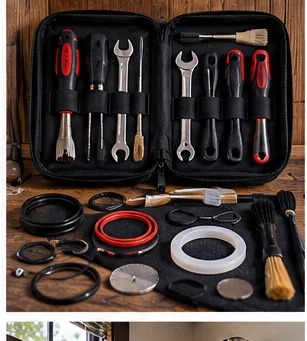
Precision metric screwdriver/bit set
Match exact fasteners before applying force.
Best when: you own serviceable prosumer equipment
Watch for: cheap bits strip stainless/brass screws
Food-safe silicone grease + gasket picks
A plastic pick reduces scratch risk.
Best when: machine uses serviceable O-rings/gaskets
Watch for: use only material compatible with the specific seal/system
Espresso maintenance brush kit
Keep brushes dedicated to coffee equipment.
Best when: you regularly remove screens and accessible parts
Watch for: brass brushes are not safe for every finish
Model-specific parts beat generic O-ring assortments
Heat, pressure and food contact make seal material important.
Magnetic trays prevent lost screws
Small stainless/brass fasteners disappear under counters instantly.
Take photos during disassembly
Routing and orientation are easier to restore from images.
Never work on a hot pressurized machine
Cool, unplug and release pressure according to the service procedure.
Know where DIY ends
A $30 tool kit should not lure you into a $1,500 boiler/control-board mistake.
Service gear should make maintenance easier, not encourage unnecessary disassembly
Brushes, blind baskets, food-safe lubricant, gasket picks, hex keys and correctly sized drivers are useful because espresso machines need routine care. They are not permission to open boilers or energized appliances without training. Basic cleaning and consumable replacement are different from electrical diagnostics, steam-boiler service and pressure-vessel work.
Organize tools by frequency. The daily brush and microfiber cloth belong beside the machine. Cafiza and blind basket can live in a maintenance drawer. Model-specific seals, screws and service tools should be labeled so the next leak does not become a parts-identification project.
Chemicals have specific jobs
Backflush detergent removes coffee oils from group components; descaler attacks mineral scale; milk-system cleaner targets dairy residues; grinder cleaner targets oils/particles in burr chambers. Do not substitute one because all four happen to be sold in white bottles.
Before checkout
- Exact machine/grinder model and size standard are confirmed
- Product solves a specific workflow, taste or maintenance problem
- Water chemistry is measured before treatment is chosen
- Replacement parts match OEM dimensions/specifications
- Food-contact materials are appropriate
- Electrical/plumbing modifications are within your skill level
- Counter space and storage are measured
- Consumables remain easy to replace
- Cleaning requirements are realistic
- Return policy allows compatibility testing
The expensive mistake is solving the wrong problem
Coffee gear is unusually good at turning a small inconsistency into a shopping list. Before buying, write the complaint in one sentence: “my machine scales every three months,” “I cannot reproduce a declining-flow shot,” “my grinder retains 0.7g,” or “I need to preserve three coffees for two months.” If the product does not address that sentence directly, it is probably a distraction.
Compatibility is the second filter. Diameter labels such as 58mm, “E61,” or 64mm burrs can look standardized while hiding important dimensional differences. Verify model, revision and actual measurements before ordering aftermarket hardware.
First-week test
Keep the old workflow as a baseline. Measure or taste several repetitions before and after the change, alter one variable at a time, and use the return window if the gear adds friction without producing a clear benefit. For maintenance parts, check for leaks, unusual noise, heat, binding or calibration changes before returning the machine to unattended daily use.
Good coffee gear should disappear into the routine. If a tool requires five minutes of setup to save ten seconds of brewing time, it needs to deliver a flavor or maintenance benefit large enough to justify that trade.
Frequently asked questions
Do I need a multimeter?
Only if you are trained to perform electrical diagnostics safely; owning the tool does not make energized work appropriate.
What lubricant is safe?
Use manufacturer-approved food-safe lubricant compatible with the seals/materials.
Should I buy generic gasket assortments?
Model-specific seals are safer for critical hot/pressurized locations.
What is the first service tool to own?
The correct group brush and driver set for routine cleaning/access.
Current sources
- CoffeeGear — Coffee Gear Maintenance Guide
- CoffeeGear — Group Gaskets & Shower Screens
- Urnex Cafiza — current espresso-cleaning specs
Affiliate disclosure: CoffeeGear.co may earn from qualifying purchases through Amazon Associates and eBay Partner Network at no extra cost to you. Amazon links use scouttheory-20; eBay links use campaign 5339137014.