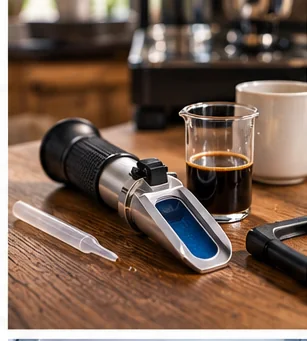
Products and configurations to compare
Coffee-specific digital refractometer
Coffee-specific calibration/range is the key.
Best when: you want beverage TDS and extraction-yield calculations
Watch for: requires clean samples, calibration and careful technique
Refractometer sample filters/syringe kit
Filtering espresso produces more repeatable readings.
Best when: oils/suspended particles distort espresso samples
Watch for: adds consumable workflow
Precision coffee scale 0.1g
Extraction yield needs both concentration and beverage/dose weights.
Best when: you need accurate beverage/dose mass for extraction calculations
Watch for: a refractometer without mass data is incomplete
TDS is concentration, not extraction yield
Extraction yield uses beverage mass, dose mass and measured concentration.
Espresso samples are messy
Crema, oils and suspended solids can destabilize optical readings.
Calibration should be routine
Use clean reference water according to the instrument procedure.
Temperature equilibration matters
Automatic compensation helps, but very hot samples still need appropriate handling.
Use the tool for experiments
It shines when comparing burrs, water, brew ratios or recipe changes under controlled conditions.
Measurement tools should answer a decision
A refractometer, pressure gauge or TDS meter can make espresso work more repeatable, but only if you know what decision the number changes. A pressure gauge can help diagnose pump/OPV behavior. A coffee refractometer can quantify beverage concentration so extraction yield can be calculated. A TDS pen measures dissolved solids in water, not espresso extraction. Buying one meter to answer all three questions is a category mistake.
Home baristas usually get more value from one accurate tool used consistently than a drawer of cheap meters. Calibration, sample preparation and repeatable technique matter more than extra decimal places on a listing.
Numbers complement taste
Extraction yield and pressure can identify why two shots taste different, but they do not declare which shot you must prefer. Use measurements to reproduce a cup you like and to isolate variables when something goes wrong.
Before checkout
- Exact machine/grinder model and size standard are confirmed
- Product solves a specific workflow, taste or maintenance problem
- Water chemistry is measured before treatment is chosen
- Replacement parts match OEM dimensions/specifications
- Food-contact materials are appropriate
- Electrical/plumbing modifications are within your skill level
- Counter space and storage are measured
- Consumables remain easy to replace
- Cleaning requirements are realistic
- Return policy allows compatibility testing
The expensive mistake is solving the wrong problem
Coffee gear is unusually good at turning a small inconsistency into a shopping list. Before buying, write the complaint in one sentence: “my machine scales every three months,” “I cannot reproduce a declining-flow shot,” “my grinder retains 0.7g,” or “I need to preserve three coffees for two months.” If the product does not address that sentence directly, it is probably a distraction.
Compatibility is the second filter. Diameter labels such as 58mm, “E61,” or 64mm burrs can look standardized while hiding important dimensional differences. Verify model, revision and actual measurements before ordering aftermarket hardware.
First-week test
Keep the old workflow as a baseline. Measure or taste several repetitions before and after the change, alter one variable at a time, and use the return window if the gear adds friction without producing a clear benefit. For maintenance parts, check for leaks, unusual noise, heat, binding or calibration changes before returning the machine to unattended daily use.
Good coffee gear should disappear into the routine. If a tool requires five minutes of setup to save ten seconds of brewing time, it needs to deliver a flavor or maintenance benefit large enough to justify that trade.
Frequently asked questions
Can a normal Brix refractometer measure coffee?
Generic instruments are not necessarily calibrated/optimized for coffee TDS and extraction workflows.
Do I need one to make great coffee?
No.
What else do I need?
Accurate dose/beverage weights and a consistent brewing process.
Can it tell me if coffee tastes good?
No; it quantifies concentration to support sensory evaluation.
Current sources
Affiliate disclosure: CoffeeGear.co may earn from qualifying purchases through Amazon Associates and eBay Partner Network at no extra cost to you. Amazon links use scouttheory-20; eBay links use campaign 5339137014.