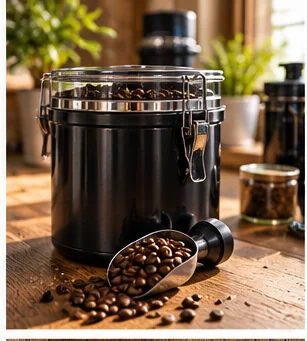
Products and configurations to compare
Fellow Atmos vacuum canister
Current Fellow guidance says twist every 4–5 days to maintain vacuum.
Best when: you use one coffee for days at a time
Watch for: manual version needs vacuum refreshed periodically and fine grounds are not recommended
Single-dose bean cellar tubes
Useful when workflow speed matters more than bulk capacity.
Best when: you rotate coffees or pre-dose espresso
Watch for: expensive per gram stored and takes rack space
Small airtight opaque canister
Often enough for 1–2 week consumption.
Best when: you finish bags quickly
Watch for: does not actively evacuate air
Vacuum is strongest for bulk daily use
One container holds the whole bag while reducing headspace oxygen.
Cellars remove weighing friction
Each dose is ready to dump into the grinder.
Transparent tubes need light awareness
Do not leave premium coffee in direct sun for display.
Freezer use changes the decision
Individual tubes or sealed portions are attractive for long-term rotation.
Do not overbuy storage for fast consumption
Fresh purchasing cadence beats elaborate hardware.
Daily storage and long-term preservation need different gear
A vacuum or displacement canister is convenient for beans you open every morning. Long-term freezing works best when the coffee is divided into portions that can stay sealed until use. Repeatedly opening a large freezer bag invites condensation and defeats much of the point.
Single-dose tubes and bean cellars primarily improve workflow and dose organization. They are not automatically superior preservation systems. A beautiful rack of exposed transparent tubes beside a sunny espresso machine can age coffee faster than an opaque bag in a cool cabinet.
Buy storage around your consumption rate
If a 12-ounce bag disappears in ten days, elaborate long-term storage is unnecessary. Storage gear becomes more valuable when you rotate several coffees, buy larger bags, freeze rare lots or prepare doses for a high-speed espresso workflow.
Before checkout
- Exact machine/grinder model and size standard are confirmed
- Product solves a specific workflow, taste or maintenance problem
- Water chemistry is measured before treatment is chosen
- Replacement parts match OEM dimensions/specifications
- Food-contact materials are appropriate
- Electrical/plumbing modifications are within your skill level
- Counter space and storage are measured
- Consumables remain easy to replace
- Cleaning requirements are realistic
- Return policy allows compatibility testing
The expensive mistake is solving the wrong problem
Coffee gear is unusually good at turning a small inconsistency into a shopping list. Before buying, write the complaint in one sentence: “my machine scales every three months,” “I cannot reproduce a declining-flow shot,” “my grinder retains 0.7g,” or “I need to preserve three coffees for two months.” If the product does not address that sentence directly, it is probably a distraction.
Compatibility is the second filter. Diameter labels such as 58mm, “E61,” or 64mm burrs can look standardized while hiding important dimensional differences. Verify model, revision and actual measurements before ordering aftermarket hardware.
First-week test
Keep the old workflow as a baseline. Measure or taste several repetitions before and after the change, alter one variable at a time, and use the return window if the gear adds friction without producing a clear benefit. For maintenance parts, check for leaks, unusual noise, heat, binding or calibration changes before returning the machine to unattended daily use.
Good coffee gear should disappear into the routine. If a tool requires five minutes of setup to save ten seconds of brewing time, it needs to deliver a flavor or maintenance benefit large enough to justify that trade.
Frequently asked questions
How much coffee fits in Fellow Atmos?
Fellow currently lists about 6 oz for 0.4L, 11 oz for 0.7L and up to roughly 16 oz light/medium roast for 1.2L.
Does Atmos need electricity?
Manual and electric lid versions exist.
What is a Bean Cellar?
A single-dose coffee storage system rather than one large bulk canister.
Which is better for freezing?
Portioned sealed containers/tubes are easier to remove one at a time.
Current sources
- Fellow Atmos — current official canister specs
- Weber Workshops — current Bean Cellar/accessory catalog
- CoffeeGear — Best Coffee Storage Canisters
Affiliate disclosure: CoffeeGear.co may earn from qualifying purchases through Amazon Associates and eBay Partner Network at no extra cost to you. Amazon links use scouttheory-20; eBay links use campaign 5339137014.